

Arsinoe Library Edition, 2026
The Arsinoe Library is excited to announce a new publication.
On War by Carl von Clausewitz examines the nature of armed conflict, the relationship between military action and politics, and the practical demands of command. The linked Arsinoe Library edition presents J. J. Graham’s English translation, with an introduction and notes by F. N. Maude. It identifies the translation’s first edition as 1874 and its London reprinting as 1909.
Clausewitz defines war as the use of force to compel an opponent to accept one’s will. His central argument is that war serves political purposes. Political objectives determine what military operations should accomplish and how much effort and sacrifice those objectives justify. Wars may seek an enemy’s overthrow or pursue limited gains that become bargaining assets in a peace settlement.
He distinguishes theoretical war, in which opposing forces tend toward extremes, from actual war, which is constrained by circumstances, resources, uncertainty, and political calculations. War involves the interaction of popular passions, chance and military judgment, and government policy. Its character therefore changes with the societies, leaders, and conditions involved.
A major theme is friction: the accumulation of difficulties that makes simple military tasks hard to execute. Danger, exhaustion, unreliable information, weather, and unexpected events disrupt plans. Effective commanders need courage, determination, experience, and sound judgment. Theory should develop understanding through analysis and historical examples rather than provide rigid formulas for victory.
Clausewitz separates tactics, the conduct of engagements, from strategy, the use of engagements to achieve the war’s objective. He emphasizes concentrating forces, choosing decisive objectives, sustaining morale, and exploiting success. Numbers matter, but leadership, discipline, confidence, and the army’s fighting spirit also affect outcomes. Victory includes weakening the enemy’s willingness and capacity to resist.
The book examines military organization, marches, supplies, bases, communications, terrain, and the relationship between attack and defense. Clausewitz considers defense the stronger form of warfare, while recognizing that it preserves rather than acquires. Successful defense can create opportunities for a counterattack.
Offensives lose strength as they advance through losses, supply demands, and expanding commitments. Commanders must recognize the culminating point beyond which continued attack risks reversal. Plans must account for the enemy’s sources of power and keep military operations connected to political goals.
The edition includes eight books, with the final two presented as sketches. Clausewitz’s accompanying notices acknowledge the manuscript’s unfinished state. Together, its arguments present war as a changing human activity requiring judgment, preparation, and a clear connection between political outcomes and military means.
Full Text
HTML – http://dlc.arsinoelibrary.org/Clausewitz-On-War/clausewitz-war.html
MARC 21 Bibliographic Data / MARCXML
<?xml version="1.0" encoding="UTF-8"?>
<record xmlns="http://www.loc.gov/MARC21/slim" xmlns:xsi="http://www.w3.org/2001/XMLSchema-instance" xsi:schemaLocation="http://www.loc.gov/MARC21/slim https://www.loc.gov/standards/marcxml/schema/MARC21slim.xsd">
  <leader>00000nam a2200000 a 4500</leader>
  <controlfield tag="001">clausewitz-war-graham-maude-pg1946</controlfield>
  <controlfield tag="005">20260925000000.0</controlfield>
  <controlfield tag="008">260925r19091874enka    o     000 0deng d</controlfield>
  <datafield tag="040" ind1=" " ind2=" ">
    <subfield code="a">ArsinoeLib</subfield>
    <subfield code="b">eng</subfield>
    <subfield code="e">rda</subfield>
    <subfield code="c">ArsinoeLib</subfield>
  </datafield>
  <datafield tag="100" ind1="1" ind2=" ">
    <subfield code="a">Clausewitz, Carl von,</subfield>
    <subfield code="d">1780-1831,</subfield>
    <subfield code="e">author.</subfield>
  </datafield>
  <datafield tag="245" ind1="1" ind2="0">
    <subfield code="a">On War /</subfield>
    <subfield code="c">by Carl von Clausewitz ; translated by J. J. Graham ; new and revised edition with an introduction and notes by F. N. Maude, C.B. (late R.E.) ; eighth impression in three volumes.</subfield>
  </datafield>
  <datafield tag="264" ind1=" " ind2="1">
    <subfield code="a">London :</subfield>
    <subfield code="c">1909.</subfield>
  </datafield>
  <datafield tag="300" ind1=" " ind2=" ">
    <subfield code="a">1 online resource</subfield>
  </datafield>
  <datafield tag="336" ind1=" " ind2=" ">
    <subfield code="a">text</subfield>
    <subfield code="b">txt</subfield>
    <subfield code="2">rdacontent</subfield>
  </datafield>
  <datafield tag="337" ind1=" " ind2=" ">
    <subfield code="a">computer</subfield>
    <subfield code="b">c</subfield>
    <subfield code="2">rdamedia</subfield>
  </datafield>
  <datafield tag="338" ind1=" " ind2=" ">
    <subfield code="a">online resource</subfield>
    <subfield code="b">cr</subfield>
    <subfield code="2">rdacarrier</subfield>
  </datafield>
  <datafield tag="500" ind1=" " ind2=" ">
    <subfield code="a">Title from HTML title page.</subfield>
  </datafield>
  <datafield tag="500" ind1=" " ind2=" ">
    <subfield code="a">Archival HTML edition derived from the Project Gutenberg transcription, eBook #1946, produced by Charles Keller and David Widger; released February 26, 2006, most recently updated January 27, 2021.</subfield>
  </datafield>
  <datafield tag="500" ind1=" " ind2=" ">
    <subfield code="a">Seven archaic ligature spellings have been modernised in this edition; the text is otherwise exactly as the source: manœuvre → maneuver (7); manœuvres → maneuvers (12); manœuvring → maneuvering (13); Manœuvring → Maneuvering (2); Manœuvering → Maneuvering (1); homœopathic → homeopathic (1); coup d’œil → coup d’oeil (6). On the title page the military titles of the author, translator and editor (General, Colonel, Colonel) have been omitted by editorial decision; they stand elsewhere in the text as printed.</subfield>
  </datafield>
  <datafield tag="500" ind1=" " ind2=" ">
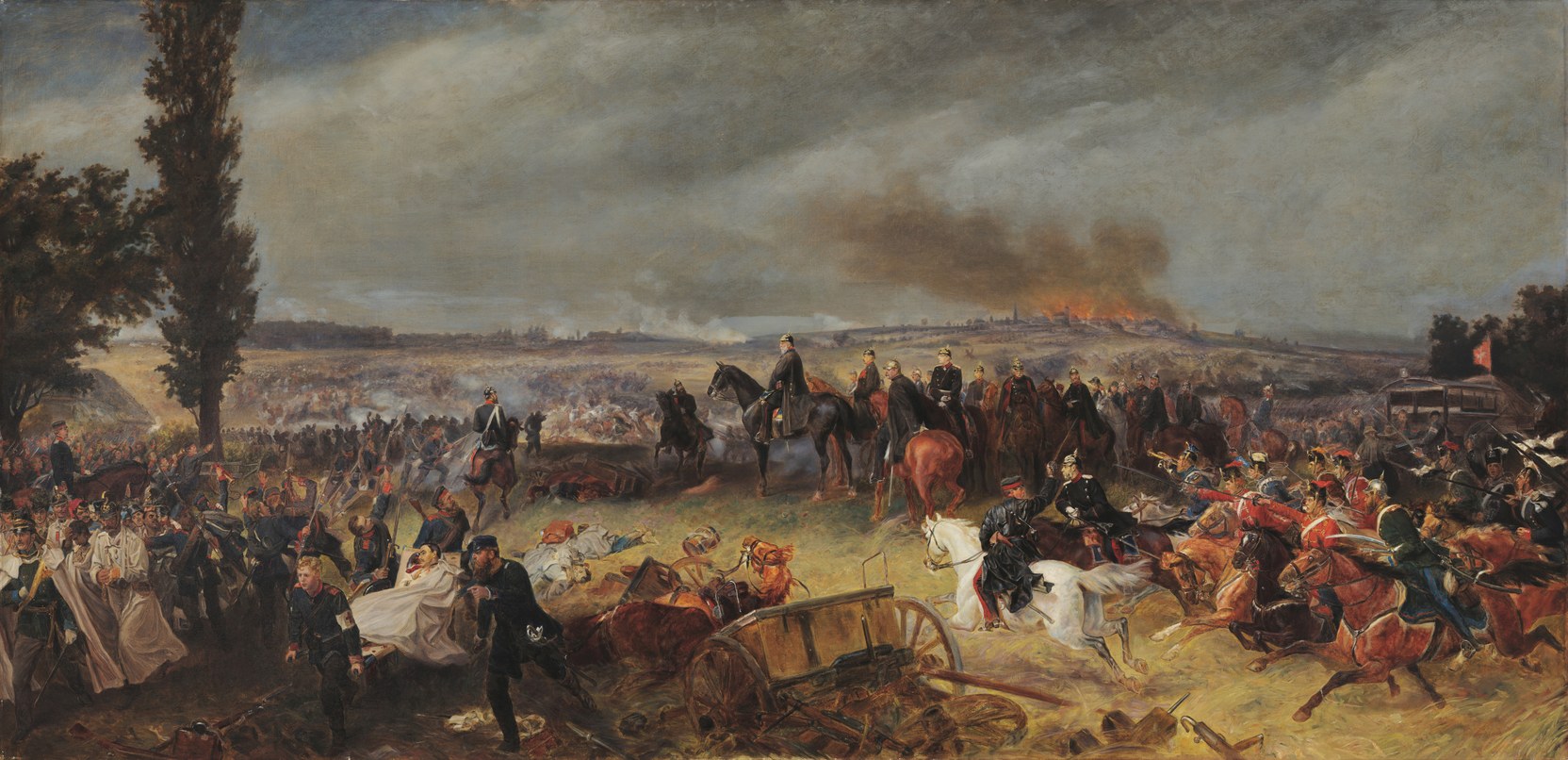
    <subfield code="a">Title/cover image, added by this Arsinoe Library edition and not part of the original 1874/1909 text; from the edition's own REFERENCE note: “Bleibtreu, 1869. Georg Bleibtreu. Title image: Die Schlacht von Königgrätz am 3. Juli 1866 (The Battle of Königgrätz on July 3, 1866). Date: circa 1869. Oil on canvas. Collection: Deutsches Historisches Museum, Berlin. Source: https://commons.wikimedia.org/wiki/File:Georg_Bleibtreu_-_Die_Schlacht_von_K%C3%B6niggr%C3%A4tz_am_3._Juli_1866.jpg. License: Public domain.”</subfield>
  </datafield>
  <datafield tag="520" ind1=" " ind2=" ">
    <subfield code="a">A treatise on the theory and conduct of war, in eight books—On the Nature of War, On the Theory of War, Of Strategy in General, The Combat, Military Forces, Defence, and, in sketch form, The Attack and Plan of War—preceded by an introduction, a preface to the first edition, a notice, the author's own introduction, and a brief memoir of Clausewitz by his translator.</subfield>
  </datafield>
  <datafield tag="546" ind1=" " ind2=" ">
    <subfield code="a">English translation.</subfield>
  </datafield>
  <datafield tag="700" ind1="1" ind2=" ">
    <subfield code="a">Graham, J. J.</subfield>
    <subfield code="q">(James John),</subfield>
    <subfield code="e">translator.</subfield>
  </datafield>
  <datafield tag="700" ind1="1" ind2=" ">
    <subfield code="a">Maude, F. N.</subfield>
    <subfield code="e">editor.</subfield>
    <subfield code="e">writer of added commentary.</subfield>
  </datafield>
  <datafield tag="856" ind1="4" ind2="0">
    <subfield code="u">http://dlc.arsinoelibrary.org/Clausewitz-war/clausewitz-war.html</subfield>
    <subfield code="y">Full text online</subfield>
  </datafield>
</record>