
Arsinoe Library Edition, 2026
The Arsinoe Library is excited to announce a new publication.
The Art of War is the world’s oldest surviving military treatise, traditionally attributed to the Chinese strategist Sun Tzŭ (Sun Wu) of the late Spring and Autumn period (c. 544–496 BCE). Lionel Giles’s 1910 English translation, produced from Chinese texts and classical commentaries while he worked at the British Museum, remains a foundational scholarly edition still widely used because it is in the public domain.
The work consists of thirteen concise chapters that treat war as a matter of profound calculation rather than brute force. Chapter I, “Laying Plans,” opens with the famous assertion that war is a matter of vital importance to the state and must be studied with the utmost care. Victory depends on five constant factors—the Moral Law, Heaven, Earth, the Commander, and Method and Discipline—and on seven comparative calculations that reveal which side holds the advantage. Sun Tzŭ insists that the highest excellence is to subdue the enemy without fighting at all.
Subsequent chapters develop this philosophy with rigorous practicality. “Waging War” stresses the economic and human cost of prolonged campaigns and urges speed. “Attack by Stratagem” ranks the options for victory: the best is to attack the enemy’s plans, next his alliances, then his army, and only last his cities. “Tactical Dispositions” and “Energy” explore the interplay of direct and indirect forces, the creation of momentum, and the use of surprise. “Weak Points and Strong” teaches the commander to appear where the enemy is unprepared and to strike where he is undefended. “Manoeuvring” and “Variation of Tactics” warn against rigid adherence to any single method and emphasize adaptability to terrain, weather, and the enemy’s condition.
Later chapters turn to concrete operational problems. “The Army on the March” and “Terrain” classify ground and prescribe how to move, camp, and fight on different types of landscape. “The Nine Situations” analyzes the psychological and strategic implications of various battlefield circumstances, from dispersive ground to desperate ground. “The Attack by Fire” details the five ways of using fire as a weapon, while the final chapter, “The Use of Spies,” elevates intelligence to the highest strategic level, arguing that foreknowledge is the key to victory and that spies are the most important of all military assets.
Throughout, Giles supplies extensive notes drawn from the Chinese commentators—Ts’ao Kung, Tu Mu, Mei Yao-ch’en, and others—clarifying obscure passages, recording variant readings, and illustrating principles with historical examples. The translation is accompanied by a substantial introduction that examines the historicity of Sun Wu, the textual tradition, earlier European translations (notably Amiot’s flawed 1772 French version and Calthrop’s imperfect 1905 English rendering), and the place of the treatise in Chinese military thought.
Modern scholarship has refined the picture. The discovery of the Yinqueshan bamboo slips in 1972 confirmed that a text close to the received version already existed by the second century BCE and also recovered material from the related Sun Pin Art of War. Later translators such as Samuel B. Griffith and Roger Ames have produced more contemporary English versions, yet Giles’s edition continues to be valued for its fidelity, its wealth of commentary, and its free availability.
The enduring power of The Art of War lies in its calm, systematic rationality. It treats conflict as a domain governed by observable principles rather than by fate or passion. Its advice—know yourself and know your enemy, avoid protracted war, exploit strength against weakness, and prefer victory by strategy to victory by slaughter—has been applied far beyond the battlefield, influencing business strategy, negotiation, sports, and even personal decision-making. Giles’s careful rendering preserves both the austere elegance of the original and the cumulative wisdom of two millennia of Chinese interpretation, making the ancient text accessible to modern readers while remaining faithful to its classical roots.
Full Text
HTML – http://dlc.arsinoelibrary.org/Sun-Art-of-War-Giles/sunzi-war-3b.html
MARC 21 Bibliographic Data / MARCXML
Title
    The Art of War
Author
    Sunzi, circa 6th century BCE.  Also known as Sun Tzu
Translator
    Lionel Giles
Language
    English
Original print date
    1910
Title image
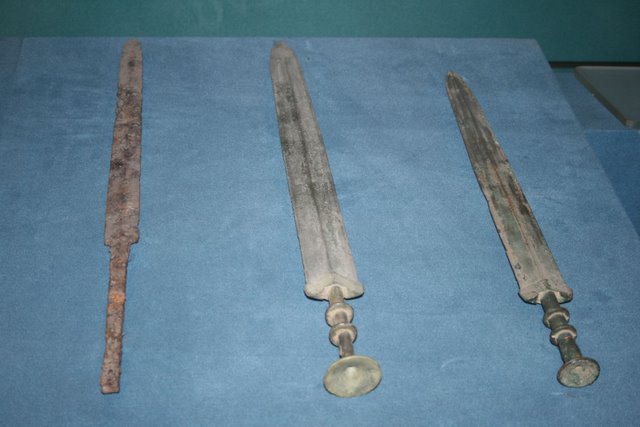
    An iron sword and two bronze swords from the Chinese Warring States Period; from the Shaanxi provincial museum, Xian, China (Gary Lee Todd, 2008).
Arsinoe Library Edition, published by the Arsinoe Library
Arsinoe Library Edition release date
    August, 2026
License
    Core text is US Public Domain.  Any text and editing additions by the Arsinoe Library are under the CC BY-SA (Creative Commons Attribution-ShareAlike) license.  Webpage and code is under the GNU General Public License (GPLv3).  The purpose of all Arsinoe Library publications is to make this work free, for everyone, forever, with proper attributions to the creators involved.  Any reproduction of this work must do so under these licenses.